An Odd Impression of Gravity: On the 2025 Arts and Culture Magazine Publishers Forum
13.12.2025

Sulje
Sulje
13.12.2025
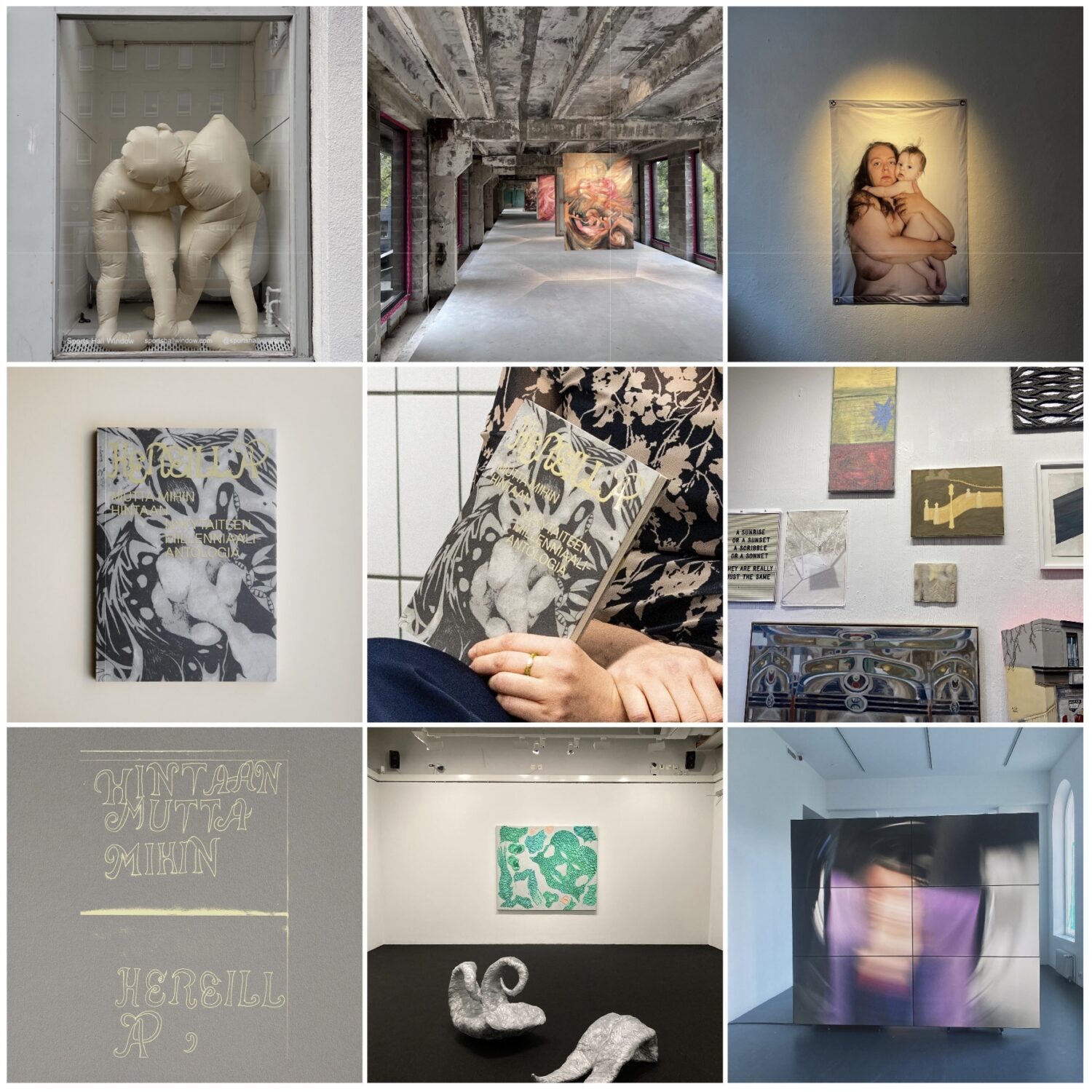
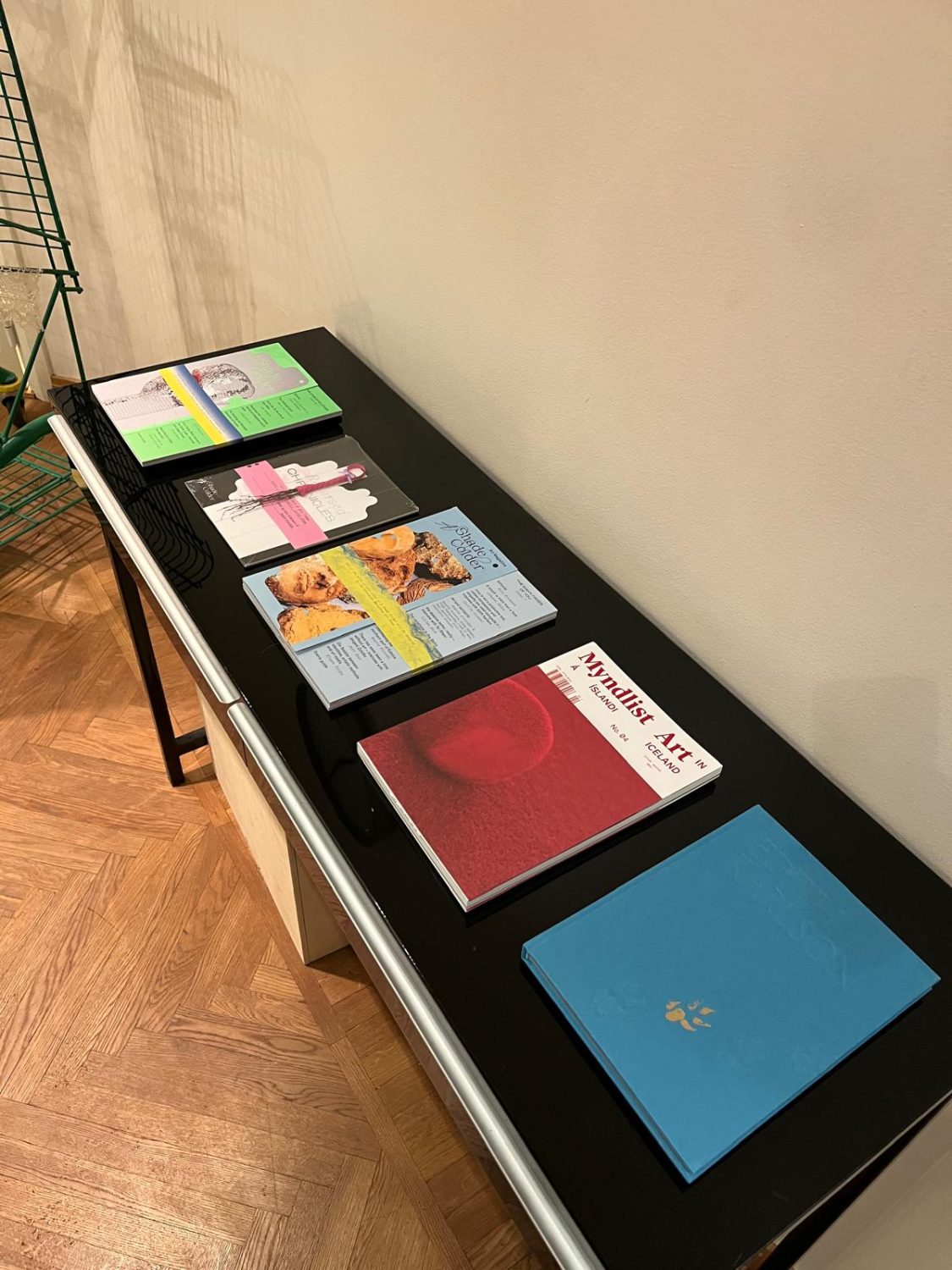
Andria Nyberg Forshage reports from the Arts and Culture Magazine Publishers Forum’s network activities in Oslo. The Forum is a network connecting contemporary art and culture magazine publishers in the Baltic and Nordic countries: A Shade Colder (Estonia), Artnews.lt and Echo Gone Wrong (Lithuania), EDIT (Finland), Kunstkritikk (the Nordics), Art in Iceland (Iceland) and Wunder Kombinat (Latvia).
In a museum in Oslo, a tank the size of an expensive toy hangs on a wall as if it’s driving across it, leaving small diagonal tracks behind in the white paint. As with many artists from across the pond shown in the Nordic countries today, the Americanness of Lutz Bacher—whose current exhibition at Oslo’s Astrup Fearnley Museum, Burning the Days, includes that Tank (2008) among cowboys and playboys—seems to precede her. Can war be read as a game of association? And could war, endlessly exported, ever be brought home to that centre of empire, as Martha Rosler and the Vietnam War protesters symbolically attempted? The tank appears weightless in its vertical climb, its put-on tracks giving an odd impression of gravity.
I cross paths with this tank as I accompany the Arts & Culture Magazine Publishers Forum—consisting of the magazines Artnews.lt, Echo Gone Wrong, Wunder Kombinat, A Shade Colder, EDIT, Myndlist á Íslandi aka Art in Iceland, and Kunstkritikk—as an external art critic on their annual research trip, which took place this October in Oslo. Its image comes back to me as I wonder what this kind of writing entails, not least in times of war and political tension. When I leave for Norway on 7 October, I fly there through turbulent airs, shielded by a pressurised chamber. The previous days have seen general strikes and massive blockades across Italy in protest of Israel’s genocide in Gaza. A networked world follows the Global Sumud Flotilla attempt to deliver aid, for which the Israeli military hijacks their ships and imprisons their activists.
Three days later, on 10 October, a ceasefire is announced. On that day, I witness and join in on a large sit-in protest at the National Museum in Oslo. It follows a months-long debate in the Norwegian arts press, starting with criticism from, among others, the artist Victor Lind, who protested the inclusion of a 1974 work by Israeli artist Noa Eshkol in a room dedicated to art ‘on the barricades’. The protesters claim that the museum legitimises genocide and fascism through its curatorial decisions, including erasure of history through mislabeling, and refusal to show Palestinian art. As one person in the room states, the ceasefire is not definite.¹ And the colonial conditions for genocide remain, as do the Israeli forces in Gaza, even if their tanks have halted their advance.
Two weeks before the Oslo trip, I had gone to visit Narva in eastern Estonia. My mom sent me worried text messages from Stockholm, having read news of Russian jets over the Bay of Finland.
On 8 October, the participants in the forum gather by the offices of Kunstkritikk at UKS in Oslo to listen to a series of presentations from Norsk Billedkunst, Kunstavisen, the Norwegian Association of Magazines and the Norwegian Critics’ Association on the state of Norwegian art criticism, its economies of private and public funding, and its publishing models. One conclusion: there is still some money in Norway. Below the conference room, in the main exhibition hall, groups of young people are making collages with prepared visual elements: Labubu, Donald Trump, the Palestinian flag, a gun. As I collage my impressions of this research trip, I feel as if I’m down there with them, attempting to make sense of the flood of symbols that signify power and politics under capitalism.

Lutz Bacher: Burning the Days at Astrup Fearnley Museet in Oslo until 4 January 2026.
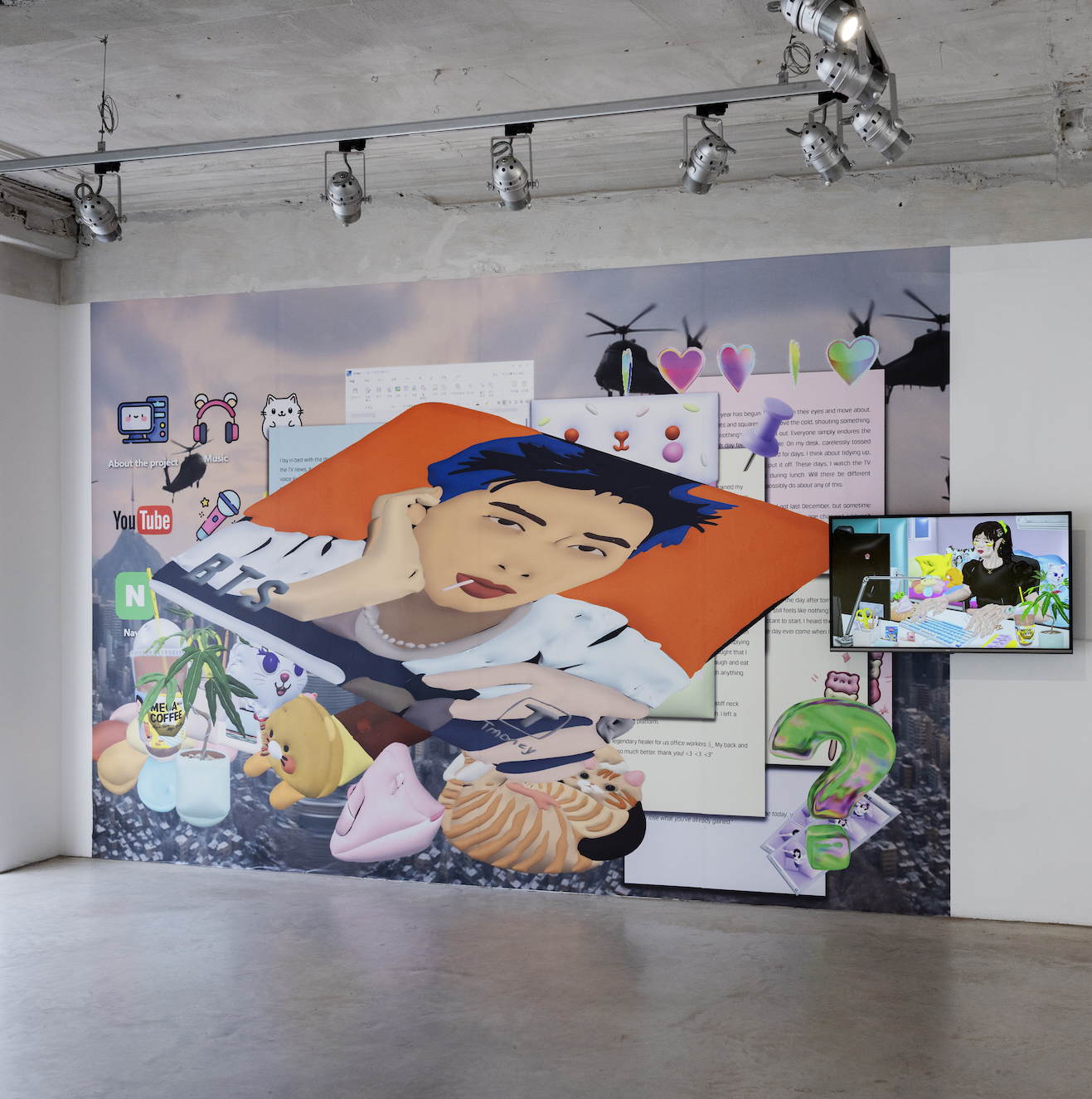
Their collaging is done within the framework of the exhibition Gratuito, Moreno y Anticolonial by Vicente Mollestad. Three large-scale mural collage works and a photobook of images gathered through Instagram document, in a kaleidoscopic way, the first three years of the art institution El Faro in El Alto, Bolivia, financed by the production budget for Mollestad’s UKS exhibition. Giving her thoughts on infrastructural curating, UKS director Miriam Wistreich later says of the show that “It didn’t have to be great”, adding that “it still turned out great”. The emphasis is on the use of the exhibition, rather than its possible aesthetic interpretation as a political utterance. In other words: here, the infrastructure is the message.
Habitually, I scan for the show’s critical implications, such as the colonialist wealth disparity made apparent when a single exhibition budget in Oslo can help found an institution in El Alto. Flipping through the catalogue, I also consider how it makes visible something of that construction of a here and there, where the “here” of the overdeveloped Western world is normalised as a space distanced and cushioned, as if abstracted, from the everyday facts of global exploitation that support it.² What manifests “here” are newspaper clippings, images, symbols, to be moved around and reassembled. These summon impressions of “there”. In cloud-driven files, they structure and manage this divide.
At the Munch Museum, on the escalators between MUNCH MONUMENTAL and MUNCH INFINITE, a light blue Labubu with Viking horns stares at me as it hangs from a tourist’s handbag. Somehow it’s the first one I’ve seen outside of Instagram. When we gather in the lobby, I look at the handbag of Kunstkritikk’s editor-in-chief. It reads: For a free Palestine. On the 10th floor, the museum is showing the video installation Zifzafa by Lawrence Abu Hamdan. In a 3D-model camera sweeps across a low-poly landscape, the video simulates panoramic views of the Golan Heights. Occupied by Israel since the 1967 war, the area is now, as the work illustrates, the site of massive construction of wind farms among the already partially displaced population, in what Abu Hamdan calls an act of green colonialism.
Exiting the gallery to the bright glass walls of the 10th story walkway invites comparison, though perhaps not correlation, with the museum’s panoramic views of Oslo’s fresh new waterfront district. Along buildings covered with solar panels, moss, and gardens, promenades bend through the fjord out to Tjuvholmen and the aspen-clad museum where I will later find Bacher’s tank on the walls. It is an enticing vista for tourists, inviting them to take part in what Visit Oslo calls eco-friendly sightseeing, or to “play green”.³
Weeks prior in Narva, I had looked, dumbly, at the border in the dark of a river. It runs between two centuries-old fortresses, one Russian and the other, Estonian, founded by the Danes and the Swedes. A week or so earlier, the airports of Oslo and Copenhagen had been forced to close their airspace due to drone sightings. The pattern comes to repeat across Europe over the following month, alongside intensified Russian bombardment against Ukrainian cities, while U.S. and Russian leaders engage in diplomatic talks without Ukraine.

Lawrence Abu Hamdan: Zifzafa at MUNCH until 4 January 2026. Photo by Ove Kvavik.
As they explain during the panel discussion “Art Under Pressure”—hosted by the ACMPF at Litteraturhuset in Oslo on the evening of 8 October—the editors of the Baltic journals had no illusions even prior to Putin’s 2022 invasion of Ukraine, even as various forms of cultural exchange and cooperation were happening. The pressures discussed over the course of the panel are many, both from within and without. A few themes reoccur: far-right parties gaining power; formal and informal restrictions on democracy and freedoms of press and expression; and deepening budget cuts, which are now motivated with appeals to the necessity of military rearmament and national security. Art workers get squeezed by economic austerity, geopolitical conflicts, and rising fascism. While Iceland, as told by Becky Forsythe (Art in Iceland), appears to me the least acutely affected; I hear from both Mariann Enge (Kunstkritikk) and Rosa Kuosmanen (EDIT) that these tendencies are grave in both Norway and Finland, as in the Sweden I am most familiar with, yet they pale in comparison.
Vitalija Jasaitė (Artnews.lt/Echo Gone Wrong) discusses how rapid political shifts in the past months have allowed for far-right and often pro-Russian populist attempts at drastic cultural takeover, including being awarded the cultural ministry, with strategies similar to those seen in recent years in Hungary, Slovakia, and Poland. In response cultural workers have organised assemblies and manifestations, managing to unseat the cultural minister. The situation is fast-changing.
I understand Elīna Ķempele (Wunder Kombinat) to say that smaller far-right parties push an anti-EU, anti-LGBT agenda which mirrors Trumpist MAGA politics, attempting to counter the gains that have been made by feminist and queer movements, while Russian hybrid provocations appear as a constant threat. Meanwhile in Estonia, where decades of neoliberal consensus has forced many cultural workers to adopt the language of start-ups, a joint statement by a number of art institutions—available here⁴—calling for an end to genocide in Gaza was met by counter-statements, and was not signed by larger institutions closer to the state, a situation Kaarin Kivirähk (A Shade Colder) sees as surprising in comparison to the broader unity in support of Ukraine.
I gather that the Baltic countries find themselves in a difficult seat, as reliance on U.S. and NATO military support—against the possible threat of a Russian invasion similar to that against Ukraine—has also meant pressure to align with the U.S. policy of unconditional support of Israel and its genocide, and thus repression of Palestinian solidarity.
Several speakers point out how it is the far-right who bring cultural politics to the fore in their attempts to weaponise it through MAGA-style ‘culture wars’. I wonder about the correlation to a tendency noted by Kivirähk, with examples from Ukraine’s defense against Russia’s ongoing invasion, of not only the role of culture as “soft power” in the face of attempted imperial/colonial erasure, but also of artists—with parallels, Kivirähk suggests, in Palestine—becoming “cultural warriors”, whether on the frontlines or in other ways. The notion opens a question for me about how art critics could or ought to respond to the artist-as-cultural warrior in these militarised landscapes. Does one then become a national envoy, representative, strategist or spy?⁵
Such questions become increasingly pressing as state militarisation and securitisation go hand in hand with the use of media as a tool for war, as well as surveillance, and restrictions on public expression. Throughout the discussions on this trip, I am struck by how international politics have moved to the heart of any substantial debate on arts and culture. Upon reflection, it contributes to a picture of how shifting rivalries among the world’s ruling classes and pressures to step in line with imperialist agendas have continually shaped the space for culture, including in moments where a perceived distance to history – such as in the Western Europe where I grew up – allowed capitalism, dressed up in contemporary art, to present itself as post-political.

Panel discussion “Art Under Pressure” hosted by the ACMPF at Litteraturhuset on 8 October 2025. Photo by Jannik Abel.
For a moment, my heavy thoughts are dispelled by an encounter on the streets of Oslo. Surprisingly, it is art.
As we pass Rosenkrantz’ gate, the group draws my attention to the public art installation Queer Utopia by Damien Ajavon. Consisting of a series of large-scale photographic portraits, it is inspired by the 1977 book The Faggots and Their Friends Between Revolutions by Larry Mitchell with illustrations by Ned Asta, a magical portrayal of radical queer communal life within the soft-hard revolution against imperial heteropatriarchy, named here as “the men”. The portraits hung along the street represent gloriously interwoven fabulations on fabulations. I, who have been obsessively reading and re-reading the book over the past few months, am delighted to see them. A passage from the book comes to mind:
The faggots and their friends live best while empires are falling … When an empire is falling, the men become so busy opposing the rebellions elsewhere and searching for the reasons why this is happening, that they have no time to watch the faggots and their friends at home … Once the empire is gone, the cause of the present evil must be found. And the faggots and their friends along with others often get chosen. Then times get bad and the faggots and their friends fade.⁶
How to read this fable? During the panel and after, one recurring reference for how art is put under pressure is the repression ongoing in Berlin. Cancelled artists and institutions along with riot cops and deportation orders signal a break with the graffitied image of Berlin of the early 2000s as a hole-y space for faggots and their friends to play, an incoherent capital in the receding tides of multiple falling empires. Empires which now, led by besuited men flanked by other similar men and a few power-dressed women, are doing their best to become Great Again.
Ajavon’s irreverent yet no less beautiful use of the codes and fashions of high society speaks back to such imagery. To understand my impression of it, I think of the kind of irreverence discussed by Mohammed El-Kurd, for whom, against the censorship and self-policing forced upon Palestinians by colonialism, “irreverence is not just a rhetorical strategy but a form of self-preservation and defiance, a stubborn rejection of psychological subjugation. Irreverence is the discursive equivalent of standing tall.”⁷
If there is still something faggy about arts and culture, then, I might understand why the men would want to cut off its funding. Tightening the screws of culture would seem a given move for those attempting to secure their own accumulating wealth, bring about and profit from increased military industrial production along with intensified natural resource extraction, all while fortifying borders in the face of worsening global ecological crises.

Damien Ajavon: Queer Utopia at Rosenkrantz’ gate 14. Photo by Jon Gorospe.
Questions of irreverence come back to my mind as I sit on the wooden floor of the National Museum’s Room 76. Several participants take the floor to speak about the scale of the genocide in Gaza. They speak of facts and affects, outlining how Western state institutions are complicit in settler-colonial occupation, apartheid, and ethnic cleansing. They speak about the scandal that the museum’s curating of the particular work represents in this context. There is a clear demand: take down the work.⁸ There is talk of what museums could do instead, calls for the museum to take responsibility, to teach, and to lead. When the museum director appears, it is clear that when the museum speaks, it calls for further dialogue and listening, which effectively means: go home and do not continue to disrupt the institution.
The sit-in ends, in any case, when the museum closes. I get up to leave, but find it hard to walk through the galleries on the way out. After a few hours of chants, poems, comments, songs, grief and rage, reflection and righteousness, as part of a temporary collective gathering, it is difficult to assume the posture of the individual and disinterested observer that the presentation of artworks on (national) gallery walls seems to call for. I am reminded of a protest under the slogan Art Not Genocide during the opening of the Venice Biennale the previous year. While pressuring for the boycott and closure of Israel’s pavilion—with further protests directed, for instance, at Germany—the mode of gathering also briefly broke the spell of that exclusive and professional space of appearance. When the protest is over, do you just continue browsing, perhaps mingling, within that walled garden?
When people at the National Museum shouted “Our museum!”, on which word did the emphasis lie?⁹ At UKS, the gallery display is secondary to the strategic redeployment of infrastructural resources. The institution feels up-to-date. Over an afternoon at National Museum, the museum becomes both an object of critique and a space for manifestation, perhaps temporary occupation, a national unifier or divider, as well as a counterpart in dialogue. Space opens up and closes down, perhaps in the same movement. In either case, even as art comes under pressure, its stone walls appear solid.
Solid enough to crawl on, even, like Bacher’s tank on the wall of the private museum. I wonder in which direction that tank is crawling. How its detailed white tracks relate, or do not relate, to anti-tank ditches now being dug across eastern Estonia, to the rubble and mass death caused by Israeli tanks, guns, drones and jets (many of them made in the U.S., Germany, UK, Italy…) in Gaza; to Russian tanks now amid trenches and occupied towns in Ukraine; to U.S. tanks invading and occupying Iraq during the same decade Bacher made the work. How far would it have to roll through a city like Oslo, which, with its islands and gardens of wealth, might resemble the U.S. or any other metropolitan center, to reach any of those innumerable upturned landscapes?
Is it a too-flippant visual joke, or well-placed irreverence?
¹ In the weeks since the ceasefire, the Israeli military has killed at least 345 people in Gaza. https://www.politico.com/news/2025/11/26/ceasefire-bodies-returned-gaza-00670567 (20251128)
² Attempting to catch up, I gather that Bolivia—once the target of a CIA-backed coup and military dictatorship in the 1970s—now has a right-wing government. I read that the U.S. welcomes the new government, which says it will restore diplomatic relations with Israel after the previous socialist party government had severed ties in response to the Gaza genocide.
³ “Play green – Eco-friendly activities in Oslo”, Visit Oslo, https://www.visitoslo.com/en/your-oslo/green-oslo/play-green/ (20251101)
⁴ “Joint Appeal by Estonian cultural institutions to end the genocide in Gaza” https://www.instagram.com/p/DPTQBgUjKig/?utm_source=ig_web_copy_link&igsh=MzRlODBiNWFlZA (from 20251102)
⁵ Soon after; I come across a passage by theorist Alexander Kluge: “A theoros escorts the envoy of one city to a foreign city. He is not supposed to conduct negotiations himself. He is supposed to observe: to find out whether the foreigners even understand what the envoy is saying. Whether the foreigners are lying. Above all: whether his own people are lying. He looks around the foreign city. He looks into the temples to see what treasures are stored there. After just a few days he knows the foreigners’ habits. Only SKIN CONTACT would yield more experience than what the theoretician gathers.” (Alexander Kluge and Ben Lerner, The Snows of Venice, Leipzig: Spector Books, 2018. p. 171)
⁶ Larry Mitchell and Ned Asta, The Faggots and Their Friends Between Revolution, New York: Calamus Press, 1977, 3rd printing 1988, p. 3.
⁷ Mohammed El-Kurd, Perfect Victims and the Politics of Appeal, Chicago: Haymarket Books, 2024, chap. 9.
⁸ See among other articles by Victor Lind, Hanan Benammar, and Mariann Enge in the Norwegian edition of Kunstkritikk over the course of 2025. Mariann Enge, “Strid om israelsk kunst på Nasjonalmuseet” (20250527); Victor Lind, “Står ved kritikken mot Nasjonalmuseet” (20250917); Hanan Benammar, “Et museum mot kunstnere?” (20250925), and more.
⁹ A similar-sounding phrase was seen a short while later on social media when the current U.S. president had part of the presidential palace, known as The White House, demolished: “but this is the people’s house”.
Article image: Gratuito, Moreno y Anticolonial by Vicente Mollestad at UKS, 19 September to 9 November 2025. Photo by Jan Khür / Studio Abrakadabra.